新手上路
四星級會員
- 舊站積分
- 3261
- 舊站發表文章數
- 1711
|
樓主 |
發表於 2009-1-6 12:02:57
|
顯示全部樓層
原發表者是 alc
[B]I tend to look at VTA as "compensation for different record thickness".
I look for maximum instrument separation, highest instrument density (highest impact and loudness of single instrument), best presence of the imaging.
I use a tiny level put on the top of the arm right above the cartridge to obtain initial (coarse) adjustment and then fine tune with ears. Before that, I made crucial listening to several discs and double check the result with ears that I can trust. So I can be sure that as long as the VTF is maintained, I can use the level to get to the initial adjustment with little deviation.
"3. Treble tends to get enhanced when VTA is increased and became duller when VTA is decreased. Why is that so? What is the mechanism behind it?"
Good question, but I have no answer for it. Imaging dragging a rake on the ground and change the height of the holding hand we seem to get the picture, but it's hard to explain why. Also, this effect seems to be way out of the fine tune area, so I just neglect it.
I've thought about the VMA and its relationship with SRA, VTA etc. but finally gave up because there is nothing that I can do with it if they actually have a slight difference in between. Fine tuning VTA is the most detailed work that I am still willing to do and somehow I think it's rewarding.
[/B]
I also use maximum spreading of soundstage to optimize VTA. However, not everyone can hear soundstage in their environment and with the 1.5cm VTA adjustment range on the Graham, it is easy to hear the tonality change. Since you already use the level to adjust for record thickness, I guess there is no need to move far from there.
One reason it is easier to set VTA with soundstage changes is because vertical motion of LP contains L-R information. A slight change in L-R can be reflected in the spread of soundstage but is harder to be heard as tonal change.
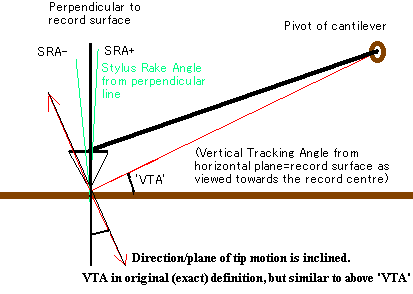
Even though researching how VMA, SRA and VTA are related is mainly academic for end users, it was something I wanted to know, I did find some information that may affect how we extract optimal signal from those grooves. For example, it was only until 1960-1961 that Bauer at the CBS lab noticed the spring back action of lacquer did they realize that the actual VMA on the lacquer was different from what they thought. The industry eventually settled on a common vertical cutting angle around 1964 but VMA from different labels can be quite different before then.
[/SIZE] |
|



 發表於 2009-1-4 09:52:33


 ] [:O]