新手上路
四星級會員
- 舊站積分
- 9
- 舊站發表文章數
- 1820
|
 發表於 2003-12-20 21:26:37
|
顯示全部樓層
B&W Matrix 801 s2 頻率響應
轉自 stereophile, December, 1987
Fig.4 shows that without the electronic equalizer, the port output, which covers the 15-50Hz region, is somewhat suppressed compared with the woofer's output. But this fundamentally overdamped alignment endows the 801 with the maximum flexibility when it comes to optimizing the speaker's interaction with the room. If you have a small room—or must use the speakers fairly close to the wall behind them, as my wife does—then you can dispense with the equalizer and still get extended bass performance, owing to the boundary reinforcement at low frequencies. In a large room that doesn't offer the same degree of low-frequency "room gain," the equalizer will bring up the low bass, the 801's damped reflex alignment minimizing any propensity for overhang that would otherwise muddy the sound. And as LL found, the presence of extended and powerful low frequencies then better balances the somewhat forward mid-treble region.
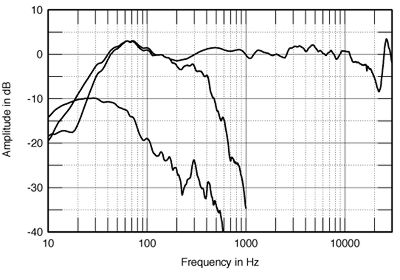
Fig.4 B&W Matrix 801, anechoic response on tweeter axis at 50", averaged across 30 degrees horizontal window and corrected for microphone response, with the nearfield woofer and port responses plotted below 1kHz and 600Hz, respectively.
Higher in frequency, the response trend (averaged across a 30 degrees lateral window on the tweeter axis) is basically flat, but with a slight excess of energy in the presence region and a corresponding lack of energy in the top octave. All things being equal, this will make the speaker both a little too revealing of recorded detail and somewhat fussy when it comes to the quality of source and amplification components, just as LL noted in his auditioning comments. |
|



 ]
 ]