新手上路
五星級會員
- 舊站積分
- 3604
- 舊站發表文章數
- 5787
|
 發表於 2017-9-19 01:44:12
|
顯示全部樓層
Part 6
Total Harmonic Distortion (THD): Is It a Good Indicator of Sound Quality?
THD(總諧波失真) 是否適合作為音質的評估指標?
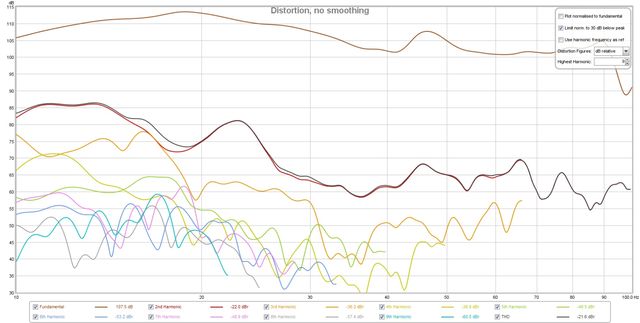
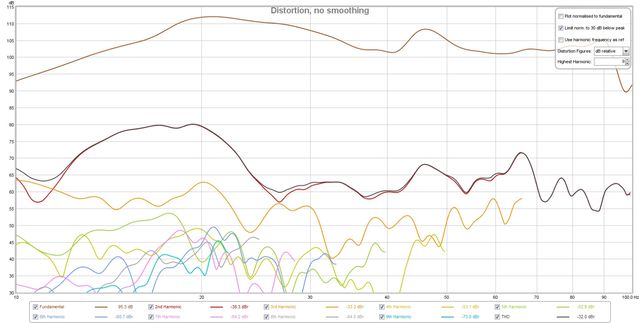
Harmonic distortion is often stated as a measurement called Total Harmonic Distortion, or THD, which is a percentage of the overall signal composed of harmonic distortion. THD is not a good indicator of how audible harmonic distortion will be unless it is of an extremely high or extremely low value. This is because there could be relatively high amounts of harmonic distortion in lower orders which could compose a substantial percentage of the output but not enough to surpass masking thresholds and so is inaudible, or there could be only be small amounts of higher order harmonic distortion which lay beyond the range of the masking, and while it may only compose a small percentage of the output, it could easily be audible.
除非特別劇烈的情況, THD 被認為不算是很好的評價音質的指標.
這是因為THD的值可能有許多是在低次諧波的量能貢獻的, 低次諧波較靠近基頻也更容易產生聽感遮蔽, 而當然還是有高次諧波因頻率距離遠而少許被聽見.
In order to determine the audibility of harmonic distortion, we need to see the component harmonics, not just the overall percentage of harmonic distortion. If we can see that the harmonics are either loud enough or of a high enough order that they will lay outside of the masked region for the fundamental, we then know that harmonic distortion will be audible.
為確定諧波失真的可聽聞程度, 通常建議觀察綜合各諧波組成而非只觀察總諧波失真(THD)數值.
如果能看到特別高的諧波音壓或是在遮蔽範圍外的高次諧波的量, 這樣的情況才比較容易被聽聞.
Let』s take a look at some of the specific examples of this which were observed by Fielder and Benjamin in their study in Table 2, which represents the maximum allowable distortion limits for the 2nd through 5th component harmonics before they became audible:

Table 2.
此表乃根據研究所擬的, 聽覺可察知的諧波失真底限.
One obvious and expected trend to see is that lower harmonics are masked much more than higher harmonics, and this, of course, is because they are much closer to the fundamental. Moreover, as was discussed, higher sound pressure levels broaden the masking levels with respect
to lower loudness levels, so more harmonics are maske as a percentage at loud levels.
表上可知如前所提, 低次諧波較易被遮蔽, 高音量會放大遮蔽範圍.
However, there is a curious feature of this data set that is worth noting.
One oddity is that at the louder tones of 100 dB and 110 dB, the lower frequencies are better at masking high order harmonics than the higher frequency tones, but not the lower frequency harmonics. For example, at 110 dB, a 20 Hz tone will mask a 2nd harmonic up to 5% of the total output and a 100 Hz tone will mask a 2nd harmonic for up to 2.5%, but for the same loudness level, a 20 Hz tone will only mask a 5th harmonic up to 0.4% while the 100 Hz tone masks the 5th harmonic up to 0.9%. This is counterintuitive to what one would expect from viewing a equal loudness chart, as the steeper slope of human sensitivity at deep frequencies would seem to indicate that further harmonics would be especially audible. This effect is due to the fact that the measured harmonic bands of the lower frequencies are much narrower than the higher frequencies; the 5th harmonic of 10 Hz and 20 Hz is to 50 Hz and 100 Hz respectively, while for 50 Hz and 100 Hz it goes to 250 Hz and 500 Hz. However the masking band of frequencies below 300 Hz remains constant due to a characteristic in our hearing known as critical bands.
有一現象值得探討:
以高音量的tone而言, 低頻基音比高頻基音較能遮蔽低次諧波, 但在高次諧波部分卻反而較差
舉例: 在110dB下,
20Hz的tone對2次諧波遮蔽5 %
100Hz的tone對2次諧波遮蔽2.5 %
同樣在110dB,
20Hz的tone對5次諧波遮蔽0.4 %
100Hz的tone對5次諧波遮蔽0.7 %
表面上似乎違背等響曲線的推演, 實際上是因為, 低頻的多次諧波涵蓋頻寬比起高頻要窄得多.
例如
10Hz的5次諧波為 50Hz
10Hz的10次諧波為 100Hz
50Hz的5次諧波為 250Hz
100Hz的5次諧波為 500Hz
人類聽覺有個稱作 "Critical bands" 的效應: 300Hz以下的遮蔽頻帶是恆定的
Very simply put, critical bands are the bandwidth around a frequency that become activated by that frequency in the human auditory system, and this neural activation causes the perception and sensing of frequencies near the center frequency to interfere with each other. It is a major factor in auditory masking, and the way critical bands act throughout the frequency spectrum of audible sounds changes, so critical bands affect bass frequencies differently than higher frequencies. Below around 200 Hz to 300 Hz, critical bandwidth is roughly a 100 Hz wide band around the center frequency. This means that higher order harmonics of extremely deep frequencies have a better chance of being masked than mid and upper bass frequencies, as their major harmonics are contained within a much closer band to the fundamental.
簡單說, Critical Bands 是聽覺系統中被某頻率基音活化的頻帶, 而此神經活化機制導致該頻率附近聽感互相干擾的現象.
這也是遮蔽效應的產生主因.
Critical Bands在高低頻的作用程度不一, 低於200-300Hz 的遮蔽帶大約100Hz寬.
所反映的意義即極低頻率的高次諧波比較容易被遮蓋, 因為離基音太近. |
|

 樓主: chucky7




 ]
 ]