忘記密碼
 立即註冊
樓主: KevinI3

我是黑膠調整的初哥

[複製鏈接]

70

主題

1054

回帖

50

積分

新手上路

三星級會員

舊站積分
345
舊站發表文章數
534
發表於 2010-6-4 13:20:14 | 顯示全部樓層

Re: Re: Re: Re: Re: Re: Re: Re: Re: Just for 初哥like me.

原發表者是 KevinI3
[B]


如何兄與謝兄所討論
主要還是在耳聽與利用一個固定的工具做為抗滑調整的判斷
減少調整的時間
目前取幾張前述的唱片做參考
基本上差異不大,所以抗滑暫時用目前的設定
再來就是墊材

最近從市場上買了一塊2mm黑金石
墊在唱盤底下
一墊上去,聲音整個鈍掉
那A按呢[] [/B]

Kevin兄,
我才計劃墊黑金石
聽您這麼說遲疑了

另您的黑金石應是2CM?not 2MM.

167

主題

8萬

回帖

0

積分

新手上路

五星級會員

舊站積分
32767
舊站發表文章數
11966
發表於 2010-6-4 14:10:45 | 顯示全部樓層

Re: Re: Re: Re: Re: Re: Re: Re: Re: Just for 初哥like me.

原發表者是 fredhsieh
[B]

以前我就是在1/4-1/2之間調,
不過好像差異不大
後來一位好友叫我大膽的把抗滑加上去
現在我認為比1多一點點是比較順耳的
不過前晚調皮
換了另一個唱頭
結果又是截然不同
顯然變數很多
沒有準則的[)] [/B]


針尖形狀不同

摩擦力(抗滑)差很大

70

主題

1054

回帖

50

積分

新手上路

三星級會員

舊站積分
345
舊站發表文章數
534
發表於 2010-6-4 15:40:20 | 顯示全部樓層

Re: Re: Re: Re: Re: Re: Re: Re: Re: Re: Just for 初哥like me.

原發表者是 wecare
[B]

針尖形狀不同

摩擦力(抗滑)差很大 [/B]


我也是這麼想.

263

主題

4488

回帖

110

積分

新手上路

五星級會員

舊站積分
1905
舊站發表文章數
3989
 樓主| 發表於 2010-6-4 17:46:24 | 顯示全部樓層

Re: Re: Re: Re: Re: Re: Re: Re: Re: Re: Just for 初哥like me.

原發表者是 fredhsieh
[B]
Kevin兄,
我才計劃墊黑金石
聽您這麼說遲疑了

另您的黑金石應是2CM?not 2MM. [/B]


yes 2cm
My LP system Turntable: roksan xerxes 20 plus Tonearm: Roksan Artemiz Cartridge: BenzMicro LPS Alive, Emotional,Dynamic and Passionate

185

主題

1548

回帖

0

積分

新手上路

四星級會員

舊站積分
964
舊站發表文章數
1121
發表於 2010-6-4 20:34:49 | 顯示全部樓層

Re: Re: Re: Re: Re: Re: Re: Re: Re: Just for 初哥like me.

原發表者是 KevinI3
[B]


如何兄與謝兄所討論
主要還是在耳聽與利用一個固定的工具做為抗滑調整的判斷
減少調整的時間
目前取幾張前述的唱片做參考
基本上差異不大,所以抗滑暫時用目前的設定
再來就是墊材

最近從市場上買了一塊2mm黑金石
墊在唱盤底下
一墊上去,聲音整個鈍掉
那A按呢[] [/B]


我家只有大瓷磚可以墊................[]

263

主題

4488

回帖

110

積分

新手上路

五星級會員

舊站積分
1905
舊站發表文章數
3989
 樓主| 發表於 2010-6-5 00:38:50 | 顯示全部樓層

Re: Re: Re: Re: Re: Re: Re: Re: Re: Re: Just for 初哥like me.

原發表者是 fredhsieh
[B]
Kevin兄,
我才計劃墊黑金石
聽您這麼說遲疑了

另您的黑金石應是2CM?not 2MM. [/B]


不過哩
再黑金石上加上這個Glory石墨小墊塊
就非常棒了
[]
My LP system Turntable: roksan xerxes 20 plus Tonearm: Roksan Artemiz Cartridge: BenzMicro LPS Alive, Emotional,Dynamic and Passionate

26

主題

1689

回帖

100

積分

新手上路

四星級會員

舊站積分
3261
舊站發表文章數
1711
發表於 2010-6-5 04:25:18 | 顯示全部樓層
Even though the friction associated with  playing a grooveless LP or an LD is different from a real LP, there are still value in doing that exercise.

--------------
1. It tells us the LOW BOND of what the anti-skating force (AF) should be.

With only the tip of the stylus touching a smooth surface, the friction, and thus resulting skating force, will be lower than the real thing.  The AF setting that balances out the inner moving force will be the minimum setting requirement.  


--------------------
2. It lets us observe how does the anti-skating mechanism work.

This article  shows the following diagram of how does skating force change across the record surface assuming friction coefficient of 0.3.
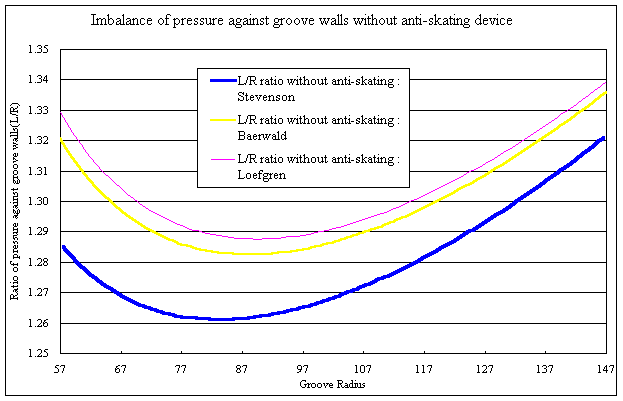


Look at the pink line.  The maximum value is 1.34 (100%) at the outer edge and the minimum value is 1.29 (96%) at about 2/3 from the edge.  If I normalize the maximum value as 100%, we can see that there is only 4% variation.

Now let's look at THEORETICALLY how well do some common anti-skating mechanisms track the theoretical variations.


The weight and string of SME 3009 provide a constant AF.  A simple and reasonable approach given that there is only 4% variation in theoretically value.

Graham 2.2 at the outer edge.   About 22 degree down.  Cos(22°) =  0.93.
Graham 2.2 at the inner edge.  About flat.  Cos(0°) = 1.0.

The torque that generates AF in the  Graham 2.2  is proportional to the horizontal part, cos(), of the bar.  Anti-skating in this case increases almost linearly from the edge (93%) to the center (100%), with about 7% changes.

FR-64fx at the outer edge.  Manual suggests that the bar be at horizontal position.  Max at 100%.

FR-64fx at the inner edge.  Cos(45°) = 0.7.


The FR-64fx has the maximum AF at the edge and decreases almost linearly (drops faster near the inner side) to about 70% of the max force at the inner edge.  

If we superimpose all those curves together, with blue line being SME, black line being Graham, and pink line being FR, we can easily see how those designs differ.  Playing an LD is a way to observe that mechanism, like Kevin did earlier.


-------------
3. We can get a feeling of how do manufacturers calibrate their AF settings.

Have you ever wonder how those 1.0g, 1.5g, ... AF setting were calibrated?  I set the AF to be the same as VTF on Graham, FR, and Signet, played an LD, and 2 of them would move slowly toward the outer edge, as one would have expected.  

The FR-64fx, on the other hand, still moved toward the center rather quickly.  With VTF of 2.0g, it took AF=2.8g just to counter the skating force  in the outer 2/3 region.  The 2.8g AF was not enough to counter the skating force within the inner 1/3 region.

It seems that Ikeda prefer low AF for some reason.  The manual of Ikeda IT-407 suggests setting AF equal to 1/2 VTF.  The AF of Ikeda designed tonearms also drops much faster toward the inner grooves than other designs. I wonder why.

17

主題

802

回帖

0

積分

新手上路

三星級會員

舊站積分
302
舊站發表文章數
522
發表於 2010-6-5 09:31:35 | 顯示全部樓層
原發表者是 hsindao
[B]Even though the friction associated with  playing a grooveless LP or an LD is different from a real LP, there are still value in doing that exercise.

--------------
1. It tells us the LOW BOND of what the anti-skating force (AF) should be.

With only the tip of the stylus touching a smooth surface, the friction, and thus resulting skating force, will be lower than the real thing.  The AF setting that balances out the inner moving force will be the minimum setting requirement.  


--------------------
2. It lets us observe how does the anti-skating mechanism work.

This article  shows the following diagram of how does skating force change across the record surface assuming friction coefficient of 0.3.


Look at the pink line.  The maximum value is 1.34 (100%) at the outer edge and the minimum value is 1.29 (96%) at about 2/3 from the edge.  If I normalize the maximum value as 100%, we can see that there is only 4% variation.

Now let's look at THEORETICALLY how well do some common anti-skating mechanisms track the theoretical variations.


The weight and string of SME 3009 provide a constant AF.  A simple and reasonable approach given that there is only 4% variation in theoretically value.

Graham 2.2 at the outer edge.   About 22 degree down.  Cos(22°) =  0.93.
Graham 2.2 at the inner edge.  About flat.  Cos(0°) = 1.0.

The torque that generates AF in the  Graham 2.2  is proportional to the horizontal part, cos(), of the bar.  Anti-skating in this case increases almost linearly from the edge (93%) to the center (100%), with about 7% changes.

FR-64fx at the outer edge.  Manual suggests that the bar be at horizontal position.  Max at 100%.

FR-64fx at the inner edge.  Cos(45°) = 0.7.


The FR-64fx has the maximum AF at the edge and decreases almost linearly (drops faster near the inner side) to about 70% of the max force at the inner edge.  

If we superimpose all those curves together, with blue line being SME, black line being Graham, and pink line being FR, we can easily see how those designs differ.  Playing an LD is a way to observe that mechanism, like Kevin did earlier.


-------------
3. We can get a feeling of how do manufacturers calibrate their AF settings.

Have you ever wonder how those 1.0g, 1.5g, ... AF setting were calibrated?  I set the AF to be the same as VTF on Graham, FR, and Signet, played an LD, and 2 of them would move slowly toward the outer edge, as one would have expected.  

The FR-64fx, on the other hand, still moved toward the center rather quickly.  With VTF of 2.0g, it took AF=2.8g just to counter the skating force  in the outer 2/3 region.  The 2.8g AF was not enough to counter the skating force within the inner 1/3 region.

It seems that Ikeda prefer low AF for some reason.  The manual of Ikeda IT-407 suggests setting AF equal to 1/2 VTF.  The AF of Ikeda designed tonearms also drops much faster toward the inner grooves than other designs. I wonder why.

[/B]


QQQ   QQQ   QQQ
﹝3Q  3Q  3Q  Thank you very much﹞

小弟的Ikeda IT-407操作手冊只薄薄幾張,而且是日本字,它不認識偶。

26

主題

1689

回帖

100

積分

新手上路

四星級會員

舊站積分
3261
舊站發表文章數
1711
發表於 2010-6-5 11:08:59 | 顯示全部樓層
原發表者是 LCL0401
[B]

QQQ   QQQ   QQQ
﹝3Q  3Q  3Q  Thank you very much﹞

小弟的Ikeda IT-407操作手冊只薄薄幾張,而且是日本字,它不認識偶。 [/B]

You can get the manual in English from Vinylengine.

http://www.vinylengine.com/library/ikeda/it-407.shtml

You will need to sign up a free account to be able to read it.  If you don't want to sign up an account, let me know your email address and I can mail one to you.

151

主題

8413

回帖

0

積分

新手上路

五星級會員

舊站積分
24833
舊站發表文章數
7074
發表於 2010-6-5 12:53:46 | 顯示全部樓層
原發表者是 hsindao
[B]Even though the friction associated with  playing a grooveless LP or an LD is different ...
[/B]

5 stars post! Thanks!
If there are more people willing to spend time like you did, this forum will shine with value.
您需要登錄後才可以回帖 登錄 | 立即註冊

本版積分規則

Archiver|MyAV視聽商情網 test

GMT+8, 2026-11-20 14:06 , Processed in 0.085969 second(s), 41 queries .

Powered by MyAV!

快速回覆 返回頂部 返回列表