新手上路
五星級會員
- 舊站積分
- 4615
- 舊站發表文章數
- 3354
|
 發表於 2009-9-14 04:50:02
|
顯示全部樓層
Linkwitzlab - Room acoustics:
At frequencies below the lowest room resonance the sound pressure will increase at a rate of 12 dB/oct for a closed box speaker that is flat under anechoic conditions, assuming that the room is completely closed and its surfaces are rigid.
This case has some significance for the interior of automobiles. Under the same circumstances the sound from a dipole speaker will stay flat.
Domestic listening spaces are seldom completely closed, nor are sheet rock walls rigid, making a prediction of very low frequency in-room response extremely difficult.
M&K家族交流討論區 537 頁 & M&K家族交流討論區 540 頁:
原發表者是 kazama
[B]
我認知的答案是: 56.67hz以下頻率仍會產生Room Gain。
請參考以下Home Theater Hifi的實測:
-------------------------------------------
http://www.hometheaterhifi.com/v ... -7-2005-part-2.html
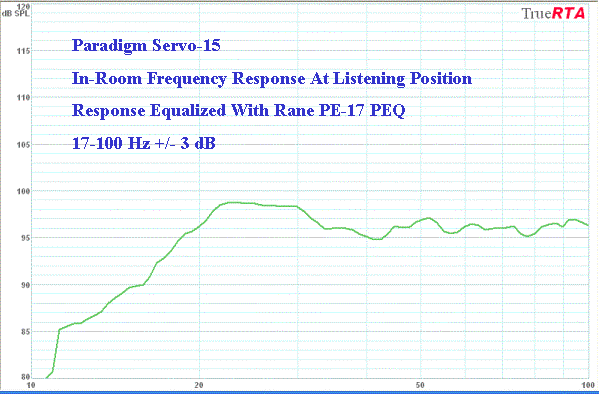
In-Room Frequency Response: The Servo-15 was placed near the front left corner of my 2,000 ft3 room.
For digital bass management, the main speakers were set to 「Small」 with a crossover frequency of 80 Hz.
The digital bass management circuit imposes a 2nd order high pass filter on the speakers, and a 4th order
low pass filter on the subwoofer. The low-pass filter switch was set to 150 Hz to prevent cascading with
the low pass filter in the digital bass management circuit.
The in-room frequency response was measured at the primary listening position (about 11 feet from the subwoofer)
with the main speakers and the subwoofer operating. Setting the subwoofer phase to 00 provided the best results,
with no obvious cancellation at the crossover frequency.
The in-room frequency response showed typical anomalies caused by room acoustics and the asymmetrical filters in
the digital bass management circuit. Considerable room gain was also observed starting below about 30 Hz. I used
my Rane PE-17 parametric equalizer to optimize the frequency response, taming room mode peaks and lessening the
effects of room gain. The final in-room FR at the listening position was approximately 17 Hz - 100 Hz ± 3 dB.
上文作者Ed Mullen在該網站論壇中提及他對Room Gain的描述:
http://www.hometheaterhifi.com/f ... dex.php/t-2766.html
Ed Mullen06-21-2005, 09:21 AM
I guess I was under the impression that if the room is too small, the lower frequencies, won't be as audible because of the wave length and cancelation and stuff. Do I not know of what I speak here?
Not true, and a popular misconception. If that were the case, you couldn't hear any bass through headphones. 
In smaller rooms the potential for cancellation (nulls) at the lower frequencies is actually reduced. When 1/2 the wavelength (of a given frequency) equals the longest lateral dimension in the room, the possibility to support a null no longer exists.
Say for example the longest diagonal in a small room is 16 feet. So any wavelength 32 feet (or larger) cannot produce
a null. And a 32 foot wavelength is about 34 Hz.
If the room is fairly rigid and enclosed, below 34 Hz the amplitude of the frequency response will actually increase
(up to a maximum of 12 dB/octave in theory but it's usually less). This phenomenon is often referred to as "room gain".
--------------------------------------------
至於Room Gain的形成原因,也容我賣個關子,先聽聽HigH兄如何以您自己
的理論來解釋您的Room Gain等於駐波(Standing Wave)的說法。 [/B]
原發表者是 kazama
[B]
請參考以下PDF文件第三頁:
http://www.acoustic-visions.com/ ... t/sealedtempest.pdf
Room Gain
The room has a tremendous effect on the low-frequency performance of any loudspeaker system.
This effect is generically referred to as room gain, although it is actually composed of two
parts: boundary gain and pressure-vessel gain.
Boundary gain arises from the driver operating not in free space but in a constrained space.
That is, the driver is typically referred to as operating in 4π space free air, but ½π space
in-room. Each boundary cuts the total 「space」 in half. Thus the floor boundary cuts the space
to 2π, the side wall cuts the space to π, and the rear wall finishes reducing the space to ½π
(also referred to as eighth space).
Pressure vessel gain comes from the fact that, below a certain frequency, the room no longer
supports standing waves; that is, the room is too small to contain a full wavelength. Contrary
to legend, this does NOT mean the room cannot 「reproduce」 such waves! Rather, it means that
the room is completely and uniformly pressurized by the input signal (we can』t call it a wave,
since it』s not a full wave). This results in a gain in acoustic pressures in the room that grows
as the frequency decreases (more gain for lower frequencies). Note that this effect is the
primary reason one can get tremendous bass levels within a car; the gain starts at a very high
frequency, thanks to the small size of the pressure vessel (car interior). [/B] |
|

 樓主: asus.V.S.acer

 ]
 ]
 ]
 )] [|)]
