忘記密碼
 立即註冊
樓主: hsindao

VTA

[複製鏈接]

26

主題

1689

回帖

100

積分

新手上路

四星級會員

舊站積分
3261
舊站發表文章數
1711
 樓主| 發表於 2009-1-17 10:10:23 | 顯示全部樓層

My interest in how VTA, SRA and VMA are related started when Mr. A graced Dallas with his presence in June.  One day I commented that VTA for mono LPs needs to be set lower than stereo LPs based on my experimentation of mostly Angel mono records with stereo cartridges.   Mr. A did not think there should be difference that got me start thinking.

Whether VTA for mono LPs should be set lower is a complicated issue and I don't quite know the answer so let's save it for later days.   One thing I am sure though:


VTA does have similar effect on mono LPs like stereo LPs.  Since mono LPs only have lateral (side)  modulations and no vertical modulation, why would small VTA adjustment make any difference?


Is it really the angle that is making differences or effective VTF changes due to VTA changes?

-------------------------------------

On a side subject, after Mr. A heard my system the first comment he said was something like "a large room really hide a lot of problem".   It was like meeting a woman for the first time and burst out "Wow, 一白遮三醜".  []

I think what he meant was that he did not hear problems that he had to struggle with at home.   It will be very informative if you can share with us what type of problem you did not hear and how would you enlarge your room if cost is not an issue, and why?

151

主題

8413

回帖

0

積分

新手上路

五星級會員

舊站積分
24833
舊站發表文章數
7074
發表於 2009-1-17 12:14:43 | 顯示全部樓層
原發表者是 hsindao

My interest in how VTA, SRA and VMA are related started when Mr. A graced Dallas with his presence.  One day I commented that VTA for mono LPs needs to be set lower than stereo LPs based on my experimentation of mostly Angel mono records with stereo cartridges.   Mr. A did not think there should be difference that got me start thinking.

Whether VTA for mono LPs should be set lower is a complicated issue and I don't quite know the answer so let's save it for later days.   One thing I am sure though:


VTA does have similar effect on mono LPs like stereo LPs.  Since mono LPs only have lateral (side)  modulations and no vertical modulation, why would small VTA adjustment make any difference?


Is it really the angle that is making differences or effective VTF changes due to VTA changes?


Paradoxically, after reading so much about VMA, I started to think about changing VTA in a greater magnitude to test the validity of the VMA arc. [;)]  No sure finding yet.

I really wonder why any manufacturer would want to cut the groove in a non-vertical angle. Is that because the stylus at that time can not be mount in a perpendicular way in relation to the record surface or, there is some other reason for it. Or, the wildest guess, the groove were cut vertically, the different VMA is only hype.

Secondly, I really wish to see pictures of different cutters to understand the way it operates. Some people acknowledged that the  Ikeda 9 is the cartridge most resembling the cutter, 'cause there is no stylus shaft. What does "no stylus shaft" means? I think that means no VMA, every movement is strictly up and down, no arc.

So someone must be wrong, either the Ikeda statement or the VMA arc.


Why VTA is important? To my reasoning, adjust VTA is to get the most "fit" of the stylus to the groove wall. We already knew that the cutter has a 1um blade width and the sharpest stylus gets to 1 or 2 um, so there will be no issue of "sluggish" regarding groove fit.

Why fit? Because that is the biggest width the stylus can travel and that is the best signal that it can pick up. With a less fit, say you raise the VTA a lot and now you have the stylus side blades contacting the groove in a large angle, it can't fit into the deepest portion of the turns, it's kind of sliding along the groove, not tracking it properly.

But can we really "hear" the absolute fit of the stylus? We might be able to but need a lot of practice. If things really are what Wecare stated that different tracks possess different cutting depth, abide by this critical "fit rule" will be a pain in the   . Anyway, although I don't feel the pain in my   , I do place the turntable right behind my seat so that I can adjust the VTA and the record weight easily. []

151

主題

8413

回帖

0

積分

新手上路

五星級會員

舊站積分
24833
舊站發表文章數
7074
發表於 2009-1-17 13:48:01 | 顯示全部樓層
原發表者是 hsindao
[B]
On a side subject, after Mr. A heard my system the first comment he said was something like "a large room really hide a lot of problem".   It was like meeting a woman for the first time and burst out "Wow, 一白遮三醜".  []

I think what he meant was that he did not hear problems that he had to struggle with at home.   It will be very informative if you can share with us what type of problem you did not hear and how would you enlarge your room if cost is not an issue, and why?
[/B]


You talked like I'm a pro, but I'm really far from "knowing a lot". I don't mind to be wrong so I can speak freely, and I think I can always learn from being wrong. []

"Big room effect" is like "Big screen effect", one is awed or satisfied by the quantity of the stimulation to the sense and ignored the minor imperfections of it. In a big room, we can get a better distribution of sound energy coming out of the speakers. Since we listen to music in a narrow range of volume difference, big room do have its advantage of less bounce back and more even reverb.

I consider a room of 15-20 坪 the best for average audiophiles, 'cause most high level speakers have good energy coupling with rooms of this size. The smaller the room size, the greater the need to distribute the energy evenly, thus more struggle with the speaker setup and the wall finish.

In my room, a size of 8 坪 or so, I have to fight with excess energy often and speakers alignment becomes crucial. Due to the smaller room size, I have to sit closer to the speakers, then comes the phase coherence problem of a multi-units speaker design.

Theoretically speaking, each of the speakers should have their own sound field and sound stage, imaging etc. and those two should match seamlessly to created a hologram of the recording scene, whether that was created by the mastering engineer or the performance itself. Losing the stage and focus on one side or both will smear the final scene, the worst, you get no imaging, no sound stage, something less than a single speaker can do.

In a bigger room, the focusing becomes tolerable because you have other things to enjoy, smooth music, even pressure, the full orchestra will not sound edgy as it would in a small room. But on the other hand, too big a room will cost us money to fill in more energy to satisfy our desire.

Maybe I can make an analogy for this, try to think of the size of a basketball field. A standard field is too big for small children, too small for team Samson. Since we have a small degree of height difference, the current size of a standard field is kind of about right.

26

主題

1689

回帖

100

積分

新手上路

四星級會員

舊站積分
3261
舊站發表文章數
1711
 樓主| 發表於 2009-1-19 01:42:19 | 顯示全部樓層
原發表者是 alc
[B]
Secondly, I really wish to see pictures of different cutters to understand the way it operates. Some people acknowledged that the  Ikeda 9 is the cartridge most resembling the cutter, 'cause there is no stylus shaft. What does "no stylus shaft" means? I think that means no VMA, every movement is strictly up and down, no arc. [/B]


Here are cutter heads of Westrex, Neumann and Ortofon.  Westrex was used in US  while the other 2 are used in Europe.

Westrex

Neumann

Ortofon

Of the 3 cutting head designs, Westrex and Neumann had cutting mechanism similar to the following diagram while Ortofon used one that cut straight down.  You can see the actual pictures of Westrex cutting heads here .


The following picture are diagrams of (a) pickup stylus, (b) Ortofon cutting head after adapted the 20degree cutting angle, and (c) Westrex/Neumann cutting methods.


The following pictures are details of the cutting stylus.  Notice the beveled facet on the front of the cutting stylus.  I'll talk about the reason for it later.


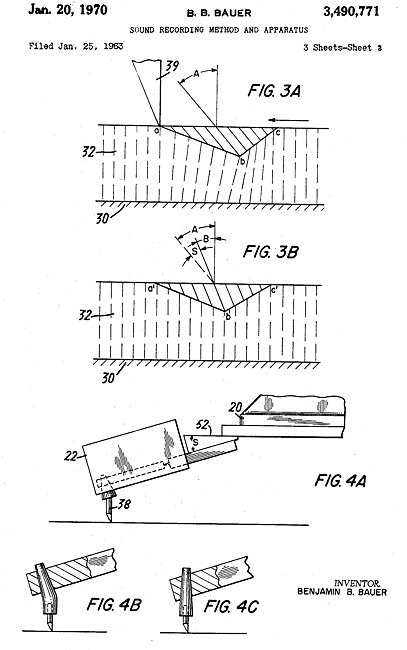
The last picture came from Bauer's patent application.  It shows the springback effect when vinyl was cut and how CBS added additional cutting angle to compensate for it.


Notice that the front edge of the cutting stylus is always near vertical even after Bauer increased the cutting angle to compensate for the springback effect.  The Ortofon diagram shows a 5 degree angle at static which will be pushed into more vertical position when the stylus is lowered onto the lacquer.


26

主題

1689

回帖

100

積分

新手上路

四星級會員

舊站積分
3261
舊站發表文章數
1711
 樓主| 發表於 2009-1-19 02:00:30 | 顯示全部樓層

Now I believe the concepts that "VTA equal to SRA" or "VMA equal to SRA" are incorrect.  The correct ones should be

1. VTA  be the same as VMA.
2. SRA be nearly vertical.  It has no relationship to VTA/VMA.

Those are consistent with what the professionals like Bauer, Josh have been saying and are also consistent with what the B&O stylus looks like.   The reason actually is very simple when you look at the following picture with the cutter head superimposed on the playing stylus:


The goal we want to achieve is to have the playing stylus mimic the motion of the cutter head.  They both will move along the red "VERTICAL MOTION ARC", which defines the VMA.  Since that arc is perpendicular to the line that defines VTA, VMA is the same as VTA.

Because the cutting edge is always near vertical regardless of whatever VMA is, we want to set the SRA of our stylus to be the same angle.  Since it may change a bit depends on how deep the lacquer was cut or how different cutter heads behave under tension, we need to adjust the SRA accordingly.  However, it is a small angle adjustment, no where as big as  VTA differences would imply.

The actual cutting stylus and the rod that holds it is much bigger than a playing stylus and what was drawn in the picture.  It still holds a cutting angle that is the same as the VTA so the motion of the cutting stylus is still the same as what was shown in the simplified picture.

26

主題

1689

回帖

100

積分

新手上路

四星級會員

舊站積分
3261
舊站發表文章數
1711
 樓主| 發表於 2009-1-20 00:54:43 | 顯示全部樓層
原發表者是 hsindao
[B]
The following pictures are details of the cutting stylus.  Notice the beveled facet on the front of the cutting stylus.  I'll talk about the reason for it later.


[/B]

In the beginning there was no burnishing facet.  The cutter stylus just had sharp front edges.  People noticed that LPs produced had quieter surfaces after a new cutting stylus had been used for a while. They found that as the cutting stylus got used, the front edge worn off and became look like the above pictures.  The front edge did the coarse cutting while the 2nd edge did the finishing cut thus produced a smoother surface.  All cutting styli were made that way thereafter.

151

主題

8413

回帖

0

積分

新手上路

五星級會員

舊站積分
24833
舊站發表文章數
7074
發表於 2009-1-20 13:10:50 | 顯示全部樓層
Absolutely great essay!
So there are two types of cutter, one with a stylus shaft and one without. That brings record playing more difficulties. Who knows which label(s) used Ortofon cutter?

With Westrex and Neumann, the length of the stylus shaft (holder) becomes important 'cause it should dictate stylus shaft length in a playback cartridge design. There are long shaft as vdH conventional ones, Benz Micro, Lyra etc. and there are short shaft like Dynavector, the new vdH Condor, Miyabi etc.. If the Westrex shaft is very much different than the Newmann's, we vinylphiles are doomed.

211

主題

2萬

回帖

150

積分

新手上路

燒膠級會員

舊站積分
9685
舊站發表文章數
21982
發表於 2009-1-20 15:34:14 | 顯示全部樓層

Neumann SX68 Cutter Head

圖中可見 coil ,

[url=http://www.myav.com.tw/bbs/showthread.php?s=&threadid=272190&perpage=12&pagenumber=290]LP 資料庫索引[/url] [url=https://www.facebook.com/%E4%BD%95%E6%B4%8B%E6%B4%8B%E7%9A%84%E9%9F%B3%E9%9F%BF%E5%AF%A6%E9%A9%97%E5%AE%A4-1147636695299945]何洋洋的音響實驗室[/url]

26

主題

1689

回帖

100

積分

新手上路

四星級會員

舊站積分
3261
舊站發表文章數
1711
 樓主| 發表於 2009-1-21 06:59:33 | 顯示全部樓層

That is a nice Neumann cutter head picture.  Thanks, Dr. H.


原發表者是 alc

With Westrex and Neumann, the length of the stylus shaft (holder) becomes important 'cause it should dictate stylus shaft length in a playback cartridge design. There are long shaft as vdH conventional ones, Benz Micro, Lyra etc. and there are short shaft like Dynavector, the new vdH Condor, Miyabi etc.. If the Westrex shaft is very much different than the Newmann's, we vinylphiles are doomed.


My previous cutter/playing styli overlay picture showed the concept of how cutting edge and SRA are aligned.  It is  misleading on the actual size.  The following picture will be closer to the real size difference (if we neglect the additional angle to compensate for springback).  As long as the angle between the cutting tip and the pivot is kept the same, it does not matter how long the shaft is.


As for Ortofon cutter head, originally they did vertical cut but when IEC specified 15 degree VMA, they came out with the solution like follows.  The cutter head is modulated in the red arrow direction so eventually all cutting machines produce similar results.


151

主題

8413

回帖

0

積分

新手上路

五星級會員

舊站積分
24833
舊站發表文章數
7074
發表於 2009-1-21 11:59:02 | 顯示全部樓層
原發表者是 hsindao
[B]
That is a nice Neumann cutter head picture.  Thanks, Dr. H.


My previous cutter/playing styli overlay picture showed the concept of how cutting edge and SRA are aligned.  It is  misleading on the actual size.  The following picture will be closer to the real size difference (if we neglect the additional angle to compensate for springback).  As long as the angle between the cutting tip and the pivot is kept the same, it does not matter how long the shaft is.


As for Ortofon cutter head, originally they did vertical cut but when IEC specified 15 degree VMA, they came out with the solution like follows.  The cutter head is modulated in the red arrow direction so eventually all cutting machines produce similar results.


[/B]


Indeed, that Neumann picture worth 3 points. [;)]

I don't quite follow your point of fixed angle between cutter edge and line connecting the pivot. My point is, if we use an Ikeda 9 to track an LP cut with a Neumann, the up and down arc will not be precisely picked up with the straight motion Ikeda. Likewise, if the Neumann cutter shaft is long and I use a very short shaft DV 17Karat to play what comes out of the Neumann, theoretically, it won't fit exactly.


About the IEC VMA, can you or anybody think of a reasonable explanation that why they want a non 0 degree cutting? Of all the turmoil of different VMA, why they want to change it, say from 15 to 22? What's the possible benefit of changing the angle that outweight the difficulty of getting proper playback?
您需要登錄後才可以回帖 登錄 | 立即註冊

本版積分規則

Archiver|MyAV視聽商情網 test

GMT+8, 2026-11-19 07:34 , Processed in 0.102842 second(s), 41 queries .

Powered by MyAV!

快速回覆 返回頂部 返回列表