新手上路
四星級會員
- 舊站積分
- 3261
- 舊站發表文章數
- 1711
|
 發表於 2009-1-4 11:31:23
|
顯示全部樓層
展覽會之畫
Like the 4 seasons mentioned above, sometimes it takes a special recording the meaning of some familiar music. A recent encounter of Sviatoslav Richter's 1958 live performance at Sofia, Bulgaria made me dig deeper into this music and changed the way I listen to it.
First, a little background. There were 3 persons involved: Mussorgsky (the composer), Hartmann(the painter), and Stasov (the critic). The three were friends. When Hartmann died at age 39, there was an exhibition of about 400 of his work. Mussorgsky went to the exhibition and was inspired to write this music. Stasov later wrote short descriptions about each picture in Mussorgsky's composition.
Most people likely are only familiar with the orchestra version transcribed by Ravel, and likely only enjoy the sound without trying to correlate music to the pictures. The Wiki contains some Hartmann's pictures described in this music. Maybe next time you can try to see how well does the music matches the pictures. Personally I found the piano version matches those pictures far better than the orchestra version.
Promenade (漫步).
Stasov: In this piece Mussorgsky depicts himself "roving through the exhibition, now leisurely, now briskly in order to come close to a picture that had attracted his attention, and at times sadly, thinking of his departed friend."
When listening to this movement, can you picture someone walking? There was a recording that sounded very rushed while another had such expensive expression as if someone were waltzing through.
2. Gnomus (侏儒).
Stasov: "A sketch depicting a little gnome, clumsily running with crooked legs."
Hartmann's sketch, now lost, is thought to represent a toy nutcracker. The following picture might give you an idea what this 侏儒 may be.

No. 2 "Il vecchio castello" (Italian: The Old Castle, 古堡)
Stasov: "A medieval castle before which a troubador sings a song."
This movement is thought to be based on a watercolor depiction of an Italian castle.
No. 3 "Tuileries" (Dispute between Children at Play) 杜樂利花園 (玩耍小孩之間的爭吵)
Stasov: "An avenue in the garden of the Tuileries, with a swarm of children and nurses."
No. 4 "Bydło" (Cattle, 牛車)
Stasov: "A Polish cart on enormous wheels, drawn by oxen."
No. 5 Ballet of the Unhatched Chicks (未孵化的小雞之舞)
Stasov: "Hartmann's design for the décor of a picturesque scene in the ballet Trilby."

No. 6 "Samuel Goldenberg und Schmuÿle" 窮富猶太人
Stasov: "Two Jews: Rich and Poor"
 Rich Jew  Poor Jew
No. 7 The Market at Limoges 裡莫日的市集
Stasov: "French women quarreling violently in the market."
No. 8 The Catacombs 地下墓穴
Stasov: "Hartmann represented himself examining the Paris catacombs by the light of a lantern."
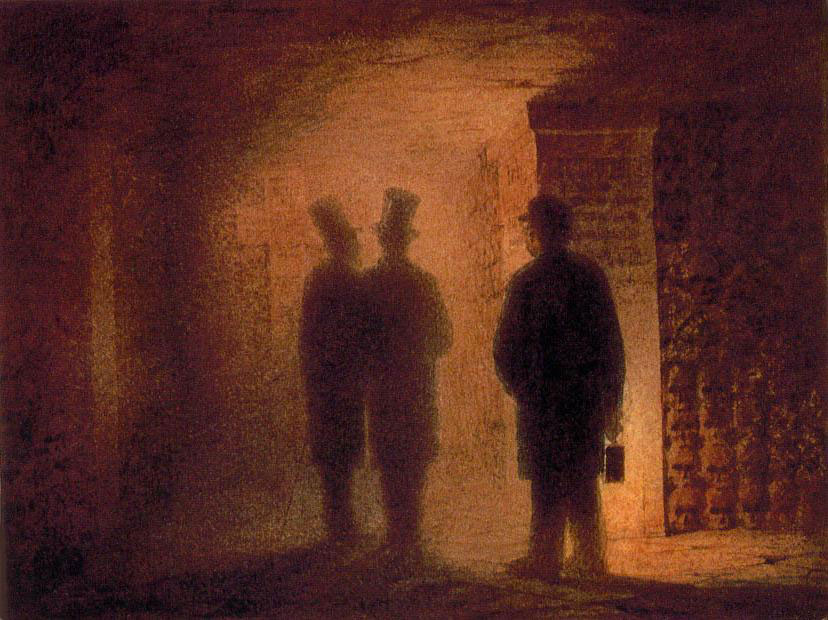
No. 9 The Hut on Hen's Legs (Baba-Yaga) 女巫的小屋
Stasov: "Hartmann's drawing depicted a clock in the form of Baba-Yaga's hut on fowl's legs. Mussorgsky added the witch's flight in a mortar."

No. 10 The Bogatyr Gates (in the Capital in Kiev) 基輔城門樓
Stasov: "Hartmann's sketch was his design for city gates at Kiev in the ancient Russian massive style with a cupola shaped like a slavonic helmet."

|
|

 樓主: alc


 )]

 ]
 ]