新手上路
五星級會員
- 舊站積分
- 508
- 舊站發表文章數
- 4372
|
 發表於 2010-5-19 16:44:45
|
顯示全部樓層
原發表者是 jcc104
[B]
I do have the same thought as you, but too much factors are involved.
「that the frictional force is essentially constant as a function of groove radius, but that it DOES change as a function of a number of other factors.」
[ ] [/B]
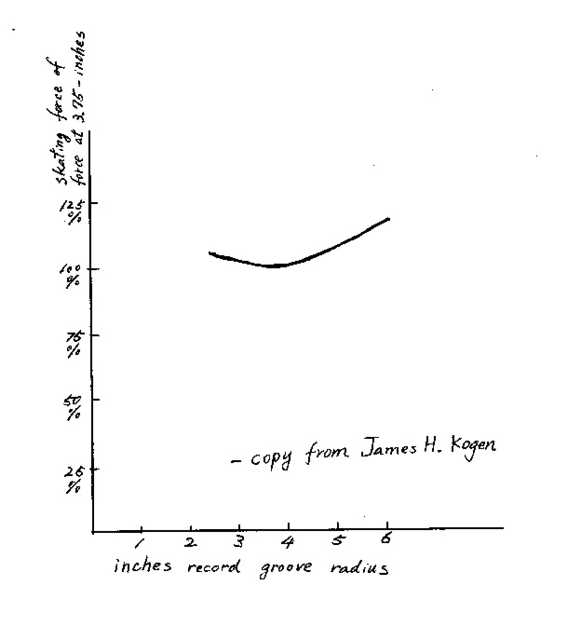
Groove raduis will dominate the general trend because the friction should increase with decrease of groove radius. However, we also need to calculate how the tracking error changes the actual force vector and thus the skate force. Additionally, due to tracking error, the stylus rod will track the direction of the actual force, creating some imbalance in sound.
If we have capability to measure friction fluctuation with frequency content, it is what effects the interaction with the cartidge.
What will also effect skate force is how it's calculated. We should calculate it in terms of moment about the pivot, this way, when we calculate the antiskate mechanism, we can compensate for it with understanding of geometry variation at various arm location because the antiskate mechanism does not apply constant moment throughout the arm travel.
What is also interesting using the skate force tool I have shown is that the change in angle represents how the sylus rod angle will vary. |
|

 樓主: jcc104